
»Reason becomes nonsense, beneficence a plague«
Goethe
While Mephistopheles’ statement referred to jurisprudence, it can all too often be applied to strategy implementation in organizations. The strategy itself always tends to sound fundamentally reasonable; after all, it would be very strange if those responsible were to proclaim: »we want to become even worse and try to deprive ourselves of our livelihood as much as possible«.
The devil is in the details of the organizational environment and the organizational design, unless we are already in a »perfect world«.1
So I will focus here on organizational design and assume that the strategy itself is reasonable and error-free.2
Usually design interventions are required to achieve the best possible results, although the result of the interventions cannot always be fully controlled or calculated.
Design is change; management designs; therefore »change management« is a tautology. Only in the ideal case does the desired result come about by itself.3
The following basic aspects can be distinguished in the context of organizational design:4

The governing (or control) body decides which intervention to implement in the design field, which can be the organization itself and/or its environment: the design domain reacts in a non-trivial manner to change interventions and can be characterized by static or dynamic equilibria.5
In the simplest case, all aspects are integrated: the control system decides on its own actions concerning itself, which accordingly limits the efficiency to itself and its own possibilities.6
Division of labour enables decomposition and (potentially) expands the design scope, but it can and will also create new problems – with the expansion of organizational possibilities, new obstacles can emerge.
Ideally, the advantages of a division of labour exceed its disadvantages: The main challenge of organizational design lies in the handling of such barriers, which have a considerable impact on the costs, throughput times and quality of organizational services and thus on the continued existence of the organization.
In general, physical and normative boundaries can be distinguished here, which can also influence each other.
Physical barriers result mainly from differences in complexity or information7 between the organizational units. Neither information nor information processing capabilities are equally distributed, which is not least a necessary condition for targeted value creation.8 As a sufficient condition, just the right information should then be available.9
Naturally limited capacities require rational ignorance and in particular no waste of resources on useless redundancies. Einstein once said »I never waste memory on things that can be stored and retrieved from elsewhere«, which is becoming increasingly simple on the one hand with computers, but on the other hand places ever higher demands on the analytical competence of its users.
Quantity is not quality; that was true long before the computer age. Combinatorics allows almost any amount of complexity to be generated from a few basic elements.10
For example, it is not difficult to produce a lot of text with little information, the opposite is much more demanding.11 Information technology offers any number of quick and easy ways to create even poetry from fragments, and machine »duckspeak« (Orwell) can hardly be distinguished from human variants.12
As an original, vivid example of such inflated redundancy, Raymond Queneau’s one hundred thousand billion (!) different poems can be used, which fit on only 10 book pages, each with a fourteen-line sonnet: the individual pages are cut under each sonnet line in such a way that each line can be combined with the lines of another page to form a new poem. Queneau calculated that it would take more than a billion years to read all of them, if you only needed one minute to read and turn the pages of a poem and did nothing else for 8 hours on 200 days a year.
In the 13th century, the Mallorcan nobleman Raimundus Lullus developed an early generic system that should be able to produce »all the truths of the Christian faith«; the following graphic shows an example of his work:

Ramon Llull produced about 265 works with an estimated 27,000 pages, which is probably due in no small part to his method.
Its power lies less in the sheer volume of generated text than in the intelligent compression of complexity into a simple basic model with enormous potential information content.13
Although such generative models seem to contain almost arbitrary amounts of information, they also require an understanding of the adequate generation of these results and sufficient decision-making competence so that no time is wasted on producing irrelevant results.14
Ultimately, it is not always guaranteed that the result set will contain a good result at all: One swallow does not make a spring, an intelligent base system alone does not guarantee an intelligent organization.
As an example, an organizational reporting system that does not adequately take into account complexity aspects becomes a source of self-dynamic bloat and ineffectiveness, up to and including effective misdirection of the organization. The more control relies on surrogates (of surrogates…) of the empirical organizational behavior, the more gaps and inconsistencies the control function shows, the more shadow organizations and consequently losses of effectiveness arise instead of the actually intended organization: control and implementation are decoupled from each other (but are usually at least pro forma coordinated).
The following »problem genesis« gives an exemplary shortened and somewhat less scientific account of the facts and circumstances:15
In the beginning was the Plan.
And then came the Assumptions.
And the Assumptions were without form, and void.
And the Plan was without substance.
And darkness was on the face of the Workers.
And the Workers spoke amongst themselves, saying,
»This is a crock of shit and it stinks.«
And the workers went unto their Supervisors and said,
»It is a pail of dung, and we can’t live with the smell.«
And the Supervisors went unto their Managers, saying,
»It is a container of excrement, and it is very strong, such that no one may abide it.«
And the Managers went unto their Directors, saying,
»It is a vessel of fertilizer, and no one may abide its strength.«
And the Directors spoke amongst themselves, saying to one another,
»It contains that which aids plant growth, and it is very strong.«
And the Directors went unto the Vice Presidents, saying,
»It promotes growth, and it is very powerful.«
And the Vice Presidents went to the President, saying unto him,
»This new plan will actively promote the growth and vigor of the company with very powerful effects.«
And the President looked upon the Plan and saw that it was good.
And the Plan became Policy.
And that is how shit happens.
If decisions or effects cannot be adequately understood and feedback on actions is only available very late (if at all), Deal and Kennedy speak — neutrally or even euphemistically — of a »process culture«; the extreme form is also known as »bureaucracy«:16

Losses of effectiveness due to physical barriers lead to cost, time and quality problems and thus fundamentally endanger the viability of the organization, even if substantial reserves may delay the »fall from the 10th floor«.17
The more process culture becomes established, the more likely it is that organizational failure should be assumed from a governance and management perspective.
The solution of the problem requires a consistent, comprehensible and ideally »complete«18 measurement system under consideration of interdependencies, as well as control interventions at the actual decision relevant level.
Industrial quality management starts directly with the production, i.e. as close as possible to the action: later corrections and consequential damages are usually much more expensive and more difficult to repair.
Quality management in decision- and knowledge-intensive areas is considerably more demanding. Where the production factors consist of information, the tools are information-based and the results in turn represent information, disinformation is followed by even more disinformation: garbage in, multiplied garbage out.
A concentration on quantified measurands is not a sufficient solution:19 organization is a quality problem long before quantification. Quantification presupposes the definition of a unit to be counted, and the identification of this unit of measurement is only trivial if it is again only numbers.
The representation of the organizational reality in the measuring system can only be as good as its construction, the measurement only as good as the person measuring, the processing only as good as the person processing.
Their decision-making competence (or »complexity potential«) represents20 a physical upper limit for the achievable results, and only by assigning a formal role this limit is not yet shifted.21
The personal-physical barrier can (with restrictions) be overcome by external consulting services. However, the consulting market basically serves every need (pecunia non olet) and often follows its very own incentive systems.22
Macchiavelli even goes so far as to suggest that one can only be well advised if one is wise oneself.
Complexity (as a measure of the information content or the variety of a system) is not something that needs to be reduced in every case from the point of view of management: it is usually lower than desirable, especially in the context of globalised knowledge economies.
The demand for complexity reduction, which is frequently expressed in organizational practice, should more appropriately be interpreted as a reduction of useless redundancies or harmful dependencies, which manifest themselves primarily as normative barriers and cause further cognitive constraints of the organization beyond the physical barriers.
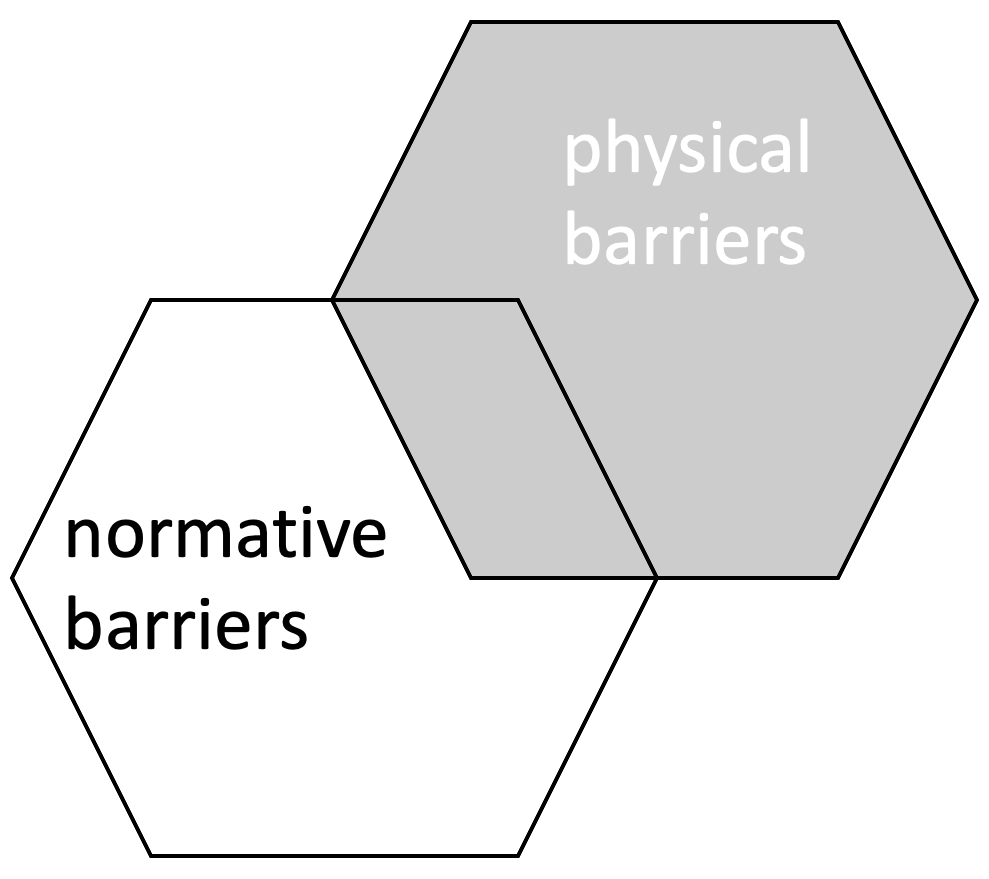
While physical barriers can be traced back to missing or faulty information (or its faulty processing), normative barriers are conflicts of objectives and evaluations which work against the organizational strategy and cause considerable complications.
Nihil fit sine causa – everything that exists is also supported, otherwise something else would have prevailed. For the status quo it is rather secondary whether this support is based on rational calculation, emergence or simple naiveté.23
On the other hand, it is of importance for its change whether resistance to change is based only on a fundamental uncertainty caused by the new, or on conflicting goals or values.
The first case is comparatively easy to handle through communication policy measures.
In the second case, the status quo, no matter how flawed, is supported by positive evaluations: what is ultimately contrary to the global strategy is considered even desirable (at least locally).24
Traduttore – tradittore: the »global rationality« of the strategy is usually in need of translation,25 or it is measured according to variables that represent dependent variables of the organizational activity (e.g. profit, market position, etc.).
These translations may be subject to random26 or arbitrary errors, it may collide with »local rationalities« or be compromised in favour of local considerations. These impairments can even be legitimized by delegation from a governance perspective – if responsibility has been delegated and results are (or cannot be) verified, they must be considered desirable, for better or worse:
who pays ultimately decides,27 and one can hardly blame someone for behaving rationally in his or her context, as long as this is done within the context of organizational rules.
Just as there are physical limits to the organizational decision-making authority, there are also hardly any surrogates for a meaningful incentive and control system.
The path of least resistance through quasi-prescribed identification with abstract values in the case of »complexity shortfall« ideally only has a symbolic effect: one cannot be trivialized and solve problems that lie outside one’s own solution space at the same time. Nevertheless, relevant, institutionalised »organizational and personnel development« and corresponding »evaluations« are very popular in advanced process cultures.
Mundus vult decipi, ergo decipiatur: depending on the quality of the organizational control system, there is a more or less creative use of gaps and interpretative leeway and consequently a progressive proliferation of organizational biotopes which de jure follow the strategy seamlessly, but de facto are largely decoupled from it and hinder its implementation.
Here structural and processual/functional dependencies can be distinguished, which are usually closely related. For example, Parkinson noted in his first law that superiors strive to increase the number of subordinates (not rivals) and tend to keep each other occupied. Inflationary growth is much quicker and easier to achieve than substantial growth and has a positive effect on the manager-to-staff ratio. If there is an obligation to contract between internal organizational units and »turnover« is a criterion for success, the slower and worse the work is done, the greater the success will be by definition. Every error correction and every need for adjustment secures and expands the fat of the land on both the contractor and the client side: in extreme cases, poor performance can become a major livelihood for both.
Process optimization initiatives and improvement projects do little to change this and at best only lead to a formalistic quality management, if the basic problem remains unsolved: in the best case, only the project budget is spent to no avail, in the worst case, the path is set in such a way that in the future even greater damage will result for the entire organization.
Success has many fathers, failure is an orphan: With increasing poor performance, the risk of this being exposed also rises. This can be countered by elaborate procedures for responsibility avoidance, so that failures can be spread over several shoulders and criticism may not find a specific starting point: Bungle no longer has to be done alone, but can be covered up or even legitimised collectively.28
Even mere knowledge can imply responsibility, and whoever decides something is basically also responsible for it. Avoidance of responsibility usually starts here and can be institutionalized by collective evaluation and decision rules, which as a side effect can lead to further mental handicaps of the organization: what is taken into account by whom and how in the decision-making process? For example, even simple majority decisions can lead to considerable impairments depending on the composition of a committee. Here is a literary case:
What is the majority? The majority is nonsense.
Understanding always lies only with the few. …
We should weigh the votes, not count them.
The state must perish sooner or later,
Where the majority triumphs and ignorance decides.
Schiller, Demetrius
Parkinson’s »comitology« does not even go so far as to take qualitative differences into account: his »inefficiency coefficient« simply corresponds to the number of people involved in a decision, above which complete ineffectiveness occurs.29
Non-decisions can have even more negative effects than wrong decisions. Parkinson’s »law of delay« says that »delay is the deadliest form of denial«:
postponing a decision paralyses and sometimes prevents it most permanently, because it also suspends all dependent decisions and possible reactions to the decision.
The examples mentioned may have a comparatively positive effect if only very poor decisions are actually to be expected as an alternative.30
From a governance perspective, the preferable approach is a sensible organizational design that consistently integrates personnel, structural, functional and process aspects into the management system, thus avoiding physical and normative barriers as far as possible.
An equally accurate as well as entertaining exemplary description of the interaction of physical and normative restrictions can be found in Parkinson’s essay on »organizational injelititis«, if incompetence is interpreted as a central physical and jealousy as a central normative barrier (emphasis added by me):
»We find everywhere a type of organization […] in which the higher officials are plodding and dull, those less senior are active only in intrigue against each other, and the junior men are frustrated or frivolous. Little is being attempted. Nothing is being achieved. […] It is the result, admittedly, of a disease, but of a disease that is largely self-induced. […] It is the disease of induced inferiority, called Injelititis […] and the diagnosis is far easier than the cure. […]
The first sign of danger is represented by the appearance in the organization’s hierarchy of an individual who combines in himself a high concentration of incompetence and jealousy. […] The two elements fuse, producing a new substance that we have termed »injelitance.« […] The specialist who observes this particular mixture of failure and ambition will at once shake his head and murmur, »Primary or idiopathic injelitance.« The symptoms, as we shall see, are quite unmistakable. […] The injelitant individual is easily recognizable […] from the persistence with which he struggles to eject all those abler than himself, as also from his resistance to the appointment or promotion of anyone who might prove abler in course of time. He dare not say, »Mr. Asterisk is too able,« so he says, »Asterisk? Clever perhaps – but is he sound?[31] I incline to prefer Mr. Cypher.« He dare not say, »Mr. Asterisk makes me feel small,« so he says, »Mr. Cypher appears to me to have the better judgment.«
Judgment is an interesting word that signifies in this context the opposite of intelligence; it means, in fact, doing what was done last time. So Mr. Cypher is promoted and Mr. Asterisk goes elsewhere. The central administration gradually fills up with people stupider than the chairman, director, or manager. If the head of the organization is second-rate, he will see to it that his immediate staff are all third-rate; and they will, in turn, see to it that their subordinates are fourth-rate. There will soon be an actual competition in stupidity, people pretending to be even more brainless than they are. […]
Cases of recovery are rare. […] It now remains to show by what symptoms its presence can be detected. […] Only a low standard is desired and one still lower is acceptable. The directives issuing from a second-rate chief and addressed to his third-rate executives speak only of minimum aims and ineffectual means. A higher standard of competence is not desired, for an efficient organization would be beyond the chief’s power to control. […] Third-rate-ness has become a principle of policy. […]
The secondary stage is recognized by its chief symptom, which is smugness. The aims have been set low and have therefore been largely achieved.[32] […S]mugness reveals itself in remarks such as this: […] »We rather distrust brilliance here. These clever people can be a dreadful nuisance, upsetting established routine and proposing all sorts of schemes that we have never seen tried. We obtain splendid results by simple common sense and teamwork.«[33]
The tertiary and last stage of the disease is one in which apathy has taken the place of smugness. […]
It would be premature, no doubt, to discuss any possible treatment in detail, but it might be useful to indicate very generally the lines along which a solution might be attempted. Certain principles, at least, might be laid down. Of such principles, the first would have to be this: a diseased institution cannot reform itself. […]
The second principle we might lay down is this, that the primary stage of the disease can be treated by a simple injection, that the secondary stage can be cured in some instances by surgery, and that the tertiary stage must be regarded at present as incurable.
There was a time when physicians used to babble about bottles and pills, but this is mainly out of date.
There was another period when they talked more vaguely about psychology; but that too is out of date, most of the psychoanalysts having since been certified as insane.
The present age is one of injections and incisions and it behooves the political scientists to keep in step with the Faculty. Confronted by a case of primary infection, we prepare a syringe automatically and only hesitate as to what, besides water, it should contain. In principle, the injection should contain some active substance – but from which group should it be selected?
A kill-or-cure injection would contain a high proportion of Intolerance, but this drug is difficult to procure and sometimes too powerful to use. Intolerance is obtainable from the bloodstream of regimental sergeant majors and is found to comprise two chemical elements, namely:
(a) the best is scarcely good enough […] and
(b) there is no excuse for anything […].
Injected into a diseased institution, the intolerant individual has a tonic effect and may cause the organism to turn against the original source of infection. While this treatment may well do good, it is by no means certain that the cure will be permanent. It is doubtful, that is to say, whether the infected substance will be actually expelled from the system. Such information as we have rather leads us to suppose that this treatment is merely palliative in the first instance, the disease remaining latent though inactive. Some authorities believe that repeated injections would result in a complete cure, but others fear that repetition of the treatment would set up a fresh irritation, only slightly less dangerous than the original disease. Intolerance is a drug to be used, therefore, with caution.
There exists a rather milder drug called Ridicule,[34] but its operation is uncertain, its character unstable, and its effects too little known. There is little reason to fear that any damage could result from an injection of ridicule, but neither is it evident that a cure would result. It is generally agreed that the injelitant individual will have developed a thick protective skin, insensitive to ridicule. It may well be that ridicule may tend to isolate the infection, but that is as much as could be expected and more indeed than has been claimed.
We may note, finally, that Castigation, which is easily obtainable, has been tried in cases of this sort and not wholly without effect. Here again, however, there are difficulties. This drug is an immediate stimulus but can produce a result the exact opposite of what the specialist intends. After a momentary spasm of activity, the injelitant individual will often prove more supine than before and just as harmful as a source of infection. If any use can be made of castigation it will almost certainly be as one element in a preparation composed otherwise of intolerance and ridicule, with perhaps other drugs as yet untried. It only remains to point out that this preparation does not as yet exist. […]
The secondary stage of the disease we believe to be operable. […] The operation […] involves, simply, the removal of the infected parts and the simultaneous introduction of new blood drawn from a similar organism. This operation has sometimes succeeded. It is only fair to add that it has also sometimes failed. The shock to the system can be too great. The new blood may be unobtainable and may fail, even when procured, to mingle with the blood previously in circulation. On the other hand, this drastic method offers, beyond question, the best chance of a complete cure.
The tertiary stage presents us with no opportunity to do anything. The institution is for all practical purposes dead. It can be founded afresh but only with a change of name, a change of site, and an entirely different staff. The temptation, for the economically minded, is to transfer some portion of the original staff to the new institution in the name, for example, of continuity.
Such a transfusion would certainly be fatal, and continuity is the very thing to avoid. No portion of the old and diseased foundation can be regarded as free from infection. No staff, no equipment, no tradition must be removed from the original site. Strict quarantine should be followed by complete disinfection. Infected personnel should be dispatched with a warm testimonial to such rival institutions as are regarded with particular hostility. All equipment and files should be destroyed without hesitation. As for the buildings, the best plan is to insure them heavily and then set them alight. Only when the site is a blackened ruin can we feel certain that the germs of the disease are dead.«
Parkinson describes the troubled organization as if the deficiencies were more or less obvious (at least for him the diagnosis is »far easier than the cure«).
However, the diagnosis is by no means easy: the combination of physical and normative barriers makes it very difficult to recognise organizational pathologies. Serious losses of effectiveness can even celebrate merry resurrections disguised as ‘efficiency’ and ‘effectiveness’;35 nonsense appears in the garment of reason, plague in the cloak of beneficence.36
Even the greatest failures can easily be praised if actual quality assurance is not possible or simply does not take place.
Such symbolic successes tend to have a multiplier effect: ex-post rationalisation can be self-reinforcing and even lead to the sustainable institutionalisation of errors. What has been positively evaluated tends to be amplified and to be repeated. A radical break with the old procedural model which already has been declared successful could ultimately be seen as an admission of failure: the better is the enemy of the good and the mortal enemy of the bad. It is also generally true that to protect one untruth, many untruths are usually necessary, which in turn triggers propagation and inflationary effects.37
The more »disinformation-intensive« the organization becomes,38 the more symbolically it treats its problems (especially when empirical design has become impossible due to manifold entanglements). Symbolic inflation and sets of rules increasingly serve the self-protection of organizational barriers instead of strategy implementation.39
In extreme cases, the organization develops serious allergies to empirical effectiveness, which can trigger immune reactions up to and including allergic shock and is sanctioned accordingly (in the case of Parkinson’s disease, this would probably correspond to third-degree injelititis).40
Attempts at improvement through hard context changes (e.g. restructuring) can alleviate the problem, but may also simply delay or even exacerbate it if the actual core problem has not been addressed.
And what is difficult to change is inevitably seen as desirable: a capitulation to the organizational immune reactions can actually be the lesser evil without a suitable starting point for effective41 change. What is considered rational is that which, despite its (officially non-existent) dysfunctionalities, serves to preserve the system: »system rationality« ultimately becomes the justification for ineffective organization and characterizes the fundamental problem of organizational design.42
Even with the most obvious potentials for improvement, empirical effectiveness requires a legitimate break with system rationality, which is essentially constituted by physical and normative barriers.43 It is very difficult to determine whether systemic resistance to change is based on good faith, malicious sabotage or simply emergence, and after all it makes little difference to the result.44
Resistances to change rarely appear openly destructive (this form is the easiest to handle and therefore has the shortest half-life). Due to multiple dependencies, deeply rooted, »systemically rationalised« aspects are difficult to change because of this very rationalisation (otherwise this dynamic equilibrium would not have been achieved in the first place). The path of least resistance can be to carry out »motivation« and »identification« initiatives, which symbolically displaces problems and helps to calm the organization in a self-referential, superficial way, but does little to change the actual causes: ineffectiveness cannot be cured by motivational posters or recitation of beliefs. Treating inflation with more of the same inevitably only leads to more inflation and consequently to even more loss of effectiveness.45
And yet organizations have fundamental problems without knowing about them. The phenomenon of Passive Disinformation, as a significant cognitive constraints, is the core problem of effective organizational design. Its discovery as the primary cause of effectiveness losses adds a qualitative dimension to the above-mentioned barriers, which itself has physical and normative implications (I call this »Qualitative Inhibition« or the »Qualitative Prisoner’s Dilemma«46) and makes it manageable at last:

This offers a conflict-relieving, legitimate and adequate starting point for a comprehensively effective handling of organizational problems. This starting point is empirically valid and easy to operationalize. Due to its ethical, cultural and political indifference, it is also generally capable of consensus: Originally innovative solutions do not have to be disruptive; on the contrary, they become comparatively soft and can be mutually agreed upon.47
You cannot push-start a stationary car from the inside: without a valid understanding of knowledge quality, there is no meaningful knowledge quality management.
This Knowledge Quality (abbr. /kei kju:/) Analysis opens up fundamentally new solutions for the organization of the organization.
- In a perfect world, the organizational targets always correspond to the current status: design interventions are not necessary. Perfect results can also be produced by ex-post rationalisation — one simply declares afterwards that the results could not have been better. The more abstract the strategy was formulated and the fewer possibilities for comparison there are, the better this succeeds. ↩︎
- For a treatment of strategic quality see Glueck, T. R.: Blind Spots in Management – Disinformation and Knowledge Quality, or Glueck, T. R.: Fractal Management ↩︎
- Game theory provides a comparatively trivial explanation for such cases: a stable solution (“Nash equilibrium”) is achieved when each player »knows« that he cannot improve further if he behaves according to this very solution. Thus an equilibrium is achieved when it is achieved. Such stable solutions can be diametrically opposed to the organizational strategy, and there can be several such solutions. Furthermore, there are games without result (a simple example is »rock, scissors, paper«), which can even lead to »halting problems« (cf. Glueck, T. R.: The Ultimate Taboo). In fact, many organizational aspects sometimes are nothing more than better or worse legitimized halting problems. ↩︎
- the picture shows scale-independent set diagrams according to the dual interpretation of the Knowledge Fractal in Glueck, T. R.: Blind Spots ↩︎
- Every state that exists does so because it is supported, otherwise it would not have come about. The support does not have to be reasonable, but can be based on coincidence, »historical« path dependencies or simply on nonsense. The nonsense can in turn be disguised as prudence and thus be relatively difficult to detect, which will be explained in more detail below. ↩︎
- When I talk about »effectiveness« in the following, I mean value-creating effectiveness in the sense of the strategy (values can also be destroyed effectively). ↩︎
- In information theory, complexity is nothing more than a measure of information ↩︎
- an excess of complexity is desirable in principle, cf. Glueck, T. R.: Rationality and Rationalisation. Heinz von Foerster’s »(Cybern)Ethical Imperative« explicitly demands that action should be taken in such a way that new alternatives arise with it (i.e. to increase the complexity of the system), Ashby’s Law demands at least »corresponding complexity« as a prerequisite for successful control. ↩︎
- »how many things exist that I do not need at all« (Goethe) ↩︎
- Depending on the recipient’s horizon of knowledge, there are regularly enough admirers for even the greatest nonsense, and hardly anything would not be able to develop a memetic life of its own. ↩︎
- »Any intelligent fool can make things bigger, more complex and more violent. It takes a touch of genius – and a lot of courage – to move in the opposite direction.« (Einstein) ↩︎
- The priest and cyberneticist H. R. Rapp remarked that »the assumption that a highly differentiated automaton can have thoughts and also feelings is less depressing than the obvious fact that there are people who do not think and have no feelings«. ↩︎
- Llull is considered a founder of artificial intelligence: His ars compendiosa inveniendi veritatem can be interpreted as the historically first »thinking machine«. ↩︎
- cf. Glück, T. R.: Possibilities and limits of information security management ↩︎
- This story has been circulating for quite some time in different forms on the www, author unknown ↩︎
- without reasonable information, there can be no stringent result orientation and no reasonable measurement of results: instead of efficiency, the amount of (possibly uselessly burned) budget is used as a status indicator; whoever has the largest budget manages the most important project or structural unit… ↩︎
- The buffer or the strength of an organization can also be based on the poor information of its customers, for example. Quite a few markets are simply based on irrationality. ↩︎
- The more levels are controlled across, the more important it becomes to reduce complexity without relevant information losses. Ideally, the control system is designed to be scale-independent. Carl von Clausewitz writes that the strategy designs a goal, »and to this goal it links the series of actions which are to lead to the same […] Since all these things can usually only be determined according to preconditions which do not all apply, but a lot of other, more detailed, determinations cannot be given beforehand, it follows of course that the strategy has to take part in the field in order to arrange the individual in place and to make the modifications which are incessantly necessary for the whole. It can therefore never withdraw its hand from the work at any moment. The fact that this […] has not always been seen in this way proves the former habit of having the strategy in the cabinet and not in the army«. ↩︎
- According to Disraeli, there are three types of lies: Lies, fucking lies and statistics. ↩︎
- Complexity is relative and looks »from below« inevitably like complicatedness, which is why there can ultimately be no surrogates for »corresponding complexity«. What people do not understand is considered complicated (as is the person who wants to explain it to them), what they cannot imagine or have not yet experienced in practice is considered »theoretical« or »abstract«. The most intelligent generative concepts are therefore the most difficult to communicate, while inappropriate, bad solutions are relatively easy to get. ↩︎
- see also Parkinson’s Injelititis Analysis or his »law of triviality«: in decision-making bodies, the time spent on discussing an agenda item is indirectly proportional to its monetary importance: the committee is more likely to discuss what those present think they understand, rather than what is more important but less understandable to them. ↩︎
- this can be relatively easily understood by a »historical« analysis of management fads and the various opinion-changing games of the relevant authors. If the complex of premises fits or is correspondingly vague, even the greatest nonsense can be well explained, and even public research is by no means free of errors (see Glueck, T. R.: The Ultimate Taboo; for a closer entertaining look behind the scenes of institutionalised innovation development I recommend Vischer, D.: Plane Deinen Ruhm). Shakespeare wrote that there is more between heaven and earth than school wisdom can dream of. Lichtenberg added that there is also more in school wisdom than heaven and earth can dream of. ↩︎
- For the emergence discussion see Glueck, T. R.: Möglichkeiten und Grenzen des Information Security Management ↩︎
- if we assume that the strategy itself is error-free (see above), this case is therefore not desirable from the point of view of the organization. ↩︎
- if it weren’t, then »work to rule« wouldn’t be part of industrial action either ↩︎
- Very bad things can also result from good intentions; according to Watzlawick, too much of a good thing regularly turns into evil ↩︎
- this is the customer, after all reserves have been used up in the case of ineffective governance,: if, as a result of the empirical losses in effectiveness, the price has become too high or the service too unattractive because the organization’s organization is mostly »symbolically efficient«, then the market simply no longer pays. ↩︎
- Cover-ups basically trigger path dependencies. One example is the famous shared skeletons in the closet, which help to stabilize otherwise unwanted relationships for a very long time and do not necessarily have a positive effect on the organization’s interests. ↩︎
- according to his not very serious analysis of government cabinets, the reasonable number is between 3 and 21; with more than 21 the organizational decline begins. ↩︎
- Or if there is a discrepancy between responsibility and control options (which is however more a fundamental organizational error than a plausible justification). ↩︎
- Cf. Nietzsche: »’I dislike him.’ – Why? – ‘I’m no match for him.’ – Has anyone ever given this sort of an answer?« Elsewhere: »If mendacity claims the word ‘truth’ for its optics at all costs, then the truthful one must be found under the worst names.« ↩︎
- This does not even have to be a smug reduction of demands: the more limited someone is, i.e. the fewer alternatives one sees, the more one can be convinced that one is actually living in the best possible of all worlds. ↩︎
- Leadership is, among other things, resource allocation; where teamwork is exaggerated as an end in itself, a reasonable use of resources is rather unlikely. ↩︎
- Parkinson and his numerous imitators ultimately belong to the »Ridicule« category themselves. ↩︎
- Efficiency (doing things right) and effectiveness (doing the right things) are also subject to the aforementioned barriers and can often only be constructed in isolating abstraction.
In the context of decision theory, an alternative is considered efficient if it is not dominated. One alternative is dominant over another if it is better with respect to at least one target variable, but otherwise not worse than the other. Apart from the construction of the decision problem (which objectives are taken into account and how are they weighted, how well measured and compared, …), in practice there is rarely real comparability: when complex projects are tendered, the outcome is not yet known (if it is even half specified); usually no comparison project is carried out, and even a before/after comparison may be of little use if the general conditions of the organization have changed in the meantime (which is the usual case): »if we had not carried out the project as decided, everything would have been much worse«.
A more recent way of avoiding responsibility is to invest in certain large-scale »standard system« projects, which have already been widely reported in the media as problematic or even unsuccessful: because it is generally known that such projects are highly problematic, one’s own suboptimal results are often anticipated and therefore accepted. For a radically simple solution to these problems see cybercortex ↩︎ - »The dirt is shining when the sun may shine« (Goethe) ↩︎
- »The lie is like a snowball, the longer you roll it, the bigger it gets.« Luther ↩︎
- The fact that an organization is knowledge-intensive does not protect against organisational nonsense, but may even make it more vulnerable, see Glueck, T. R.: Innovation ↩︎
- »Thus men prattle and teach undisturbed: Who wants to be counted with the fools? Men always believe, when they hear words, There must be thought behind them, too.« (Goethe). Or with Lessing: »Artificial words must then cover the nakedness of stupidity, and a learned quotation makes stains even into ornaments.« ↩︎
- Symbolic inflation becomes an attractor for more symbolic inflation. The members themselves may suffer most from it (for an example see the »Abilene Paradox«). ↩︎
- Criticism that does not provide better alternatives has a destructive character or risks to expose the critic as well. If a certain complexity level of the problem has been reached (and this lies in the eye of the beholder, see above), even the implementation of objectively better concepts requires a leap of faith and a separate implementation project, which involves certain risks for the client. After all, if one does not know that things could actually be much better, (s)he is satisfied with suboptimal or even bad results. ↩︎
- Depending on the evaluation basis, any rationalities can be constructed and corresponding »rationalisations«, see Glueck, T. R.: Blind Spots in Management – Disinformation and Knowledge Quality ↩︎
- This well-founded legitimation ultimately represents the missing drug in Parkinson’s injections. The simpler the »mechanic« solution to the problem would be, the more important the legitimation becomes for carrying out the obvious. A generally short-lived legitimation variant is the use of consulting or management fads. The more nebulous they are, the less comprehensible and thus less open to attack, right up to symbolic sustainability; the most popular, oldest symbols often have the least information content (see Glueck, T. R.: The Ultimate Taboo). ↩︎
- Which is worse, incompetence or sabotage? Both are equally tolerated (if not encouraged) if they can be interpreted as system rational. ↩︎
- Bubble economies can grow, shrink and sometimes burst. The crucial factor is whether the organization profits from bubbles or is itself part of them: from the fact that one serves maybe stupid markets, no obligation to one’s own stupidity follows; »The maturity of the mind shows itself in the slowness of faith« (Schopenhauer) ↩︎
- Glueck, T. R.: Blind Spots in Management – Disinformation and Knowledge Quality ↩︎
- Disruptive effects may at best be seen by the beneficiaries of the target problem. ↩︎
© 2020-2025 Dr. Thomas R. Glueck, Munich, Germany. All rights reserved.
 cybernetics, system design & ultimate taboos